Trump is firing the bipartisan commission in the latest attempt to redo the election before the midterms

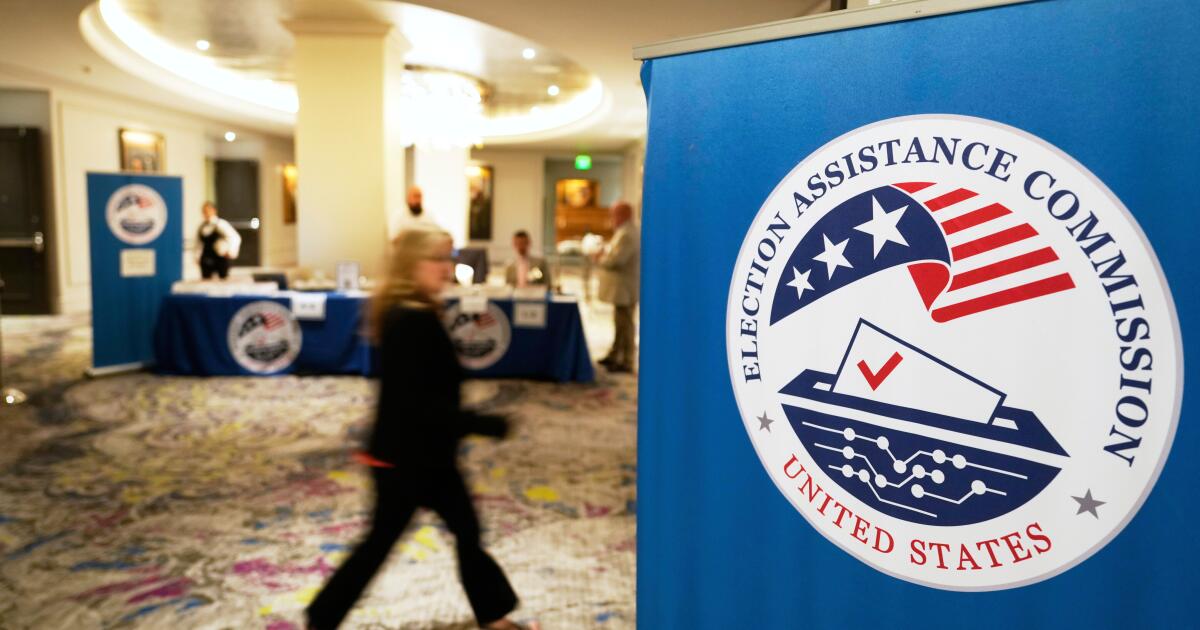
WASHINGTON – President Trump fired all remaining members of the US Election Assistance Commission this week, his latest move to control the national election in the final months before the midterm polls.
The White House defended the move as approved by a recent US Supreme Court ruling that gives the president broad powers to reshape government agencies, including replacing appointed leaders.
Democrats and some independent election experts have criticized it as politicized, against voters’ interests and foolish as the November election draws closer.
“The purge of commissioners months before the midterm elections and the continued support of our state and local election officials is an obvious part of his plan to manipulate our elections and allow illegal and dangerous election interference,” said Sen.
Padilla said the dismissal was an attempt by Trump to “undermine another independent process of our democracy designed to keep elections fair and secure.”
A White House official framed the dismissals in stark contrast, saying the departing commissioners were “completely inconsistent with the critical mission of protecting America’s elections and ensuring that every valid vote is counted.” He did not say when the president planned to appoint new commissioners.
The four-member commission was created by Congress in 2002 as part of the Help America Vote Act to help states improve their voting systems and voter outreach. By law, no more than two commissioners may belong to the same political party.
Historically, it has provided voluntary guidance and best practices for voting systems, and has served as a way to standardize election performance across the country — so states and localities can learn from each other.
Since 2018, the panel has also issued more than $1 billion in election security grants, according to a report by the Bipartisan Policy Center. Those grants are then used to protect IT systems from foreign and domestic computer attacks, update voting systems, ensure the accuracy of voter numbers and protect the integrity of votes after voting.
Without leadership, the panel cannot take any official action until new members are appointed and confirmed by the Senate.
Benjamin W. Hovland, one of the Democratic commissioners removed by Trump, told NBC News that eliminating a key federal agency designed to help state and local election administrators would have a negative impact on already troubled election officials.
“If you ask a lot of people without giving them the necessary resources, you know, mistakes happen,” he said.
California Secretary of State Shirley Weber, in a statement sent to The Times, said Trump is “inflicting unnecessary chaos, confusion and instability in the programs Americans rely on to make their voices heard,” but California “will not be intimidated or prevented” from holding elections “where everyone can participate fairly and safely.”
California Atty. Gen. Rob Bonta — whose office has already blocked federal agencies from using many of Trump’s election orders in court — called Trump’s firing “very troubling,” and said his office “will continue to monitor all efforts to weaken our democracy and fight back with every tool at our disposal.”
The office of Gov. Gavin Newsom said in X that “Newsom’s efforts to protect the election are becoming more important by the day” – referring to his recent plan to pass a state law that would make it a crime in California for anyone to confiscate ballots before the ballot is certified.
Newsom said Thursday that Trump’s efforts to seize power in the election represented a “five-alarm fire” that needed to be addressed.
Trump’s dismantling of the commission comes as he is waging a broad campaign to rewrite voting rules. He sought to impose new restrictions on voting by mail, strengthen voter ID and proof of citizenship requirements for voters, subject voter rolls to federal oversight and purging, and assert federal control over how the US Postal Service delivers ballots by mail.
Much of that agenda, driven by executive orders and other executive actions, has been blocked by the courts, while stalled in Congress, where it lacks support.
Whether Trump’s move to dissolve and re-establish the commission will prove an effective way to launch his campaign remains unclear, experts say.
David Becker, executive director of the nonpartisan Center for Election Innovation & Research, said the election commission has always had “limited authority,” can’t dictate policy in the states and lacks legislative power — meaning Trump’s ouster will have little real impact on the election.
Rick Hasen, an election law expert and director of the Project on Defending Democracy at UCLA Law, wrote that Trump could try to illegally direct the commission to “do his will” by amending the national voter registration form to require proof of citizenship — though that would have limited effect and would be challenged in court.
Sen. Adam Schiff (D-Calif.) said Trump’s firing of the commissioners was part of a broader effort by the president “to plant distrust in our voting system so he can challenge the results if he doesn’t like them.”
Kim Alexander, president of the California Voter Foundation, said California has the “strongest” election standards in the country, which will not change if the commissioners are removed.
Still, he said, voices were fired at a conference of county election officials in San Diego on Thursday — some wondering if the firings would threaten election funding, while others lamented the loss of the expertise of the ousted commissioners.
Dean Logan, head of the LA County Registrar-Recorder/County Clerk office, said in a statement sent to the Times that “any rapid change in the structure of election support during the election cycle is concerning,” but that California “has a strong local and state base of support for election management and voting systems, and that will mitigate any potential disruption caused by this action.”
In recent months, Trump has used federal agencies to change the country’s voting laws in a way no other president has ever attempted.
He has repeatedly pressed Republican lawmakers to pass federal legislation that would require voters to provide proof of citizenship when registering, show ID when voting and force states to send voter information to the Department of Homeland Security.
Republican leaders said the proposed SAVE America Act does not have enough votes to pass the Senate. The GOP opposition has angered Trump, who on Friday refused to sign the bipartisan House bill in protest.
The housing bill, which Trump called a “big yawn” last month, would have become law at midnight Friday without Trump’s signature.


