
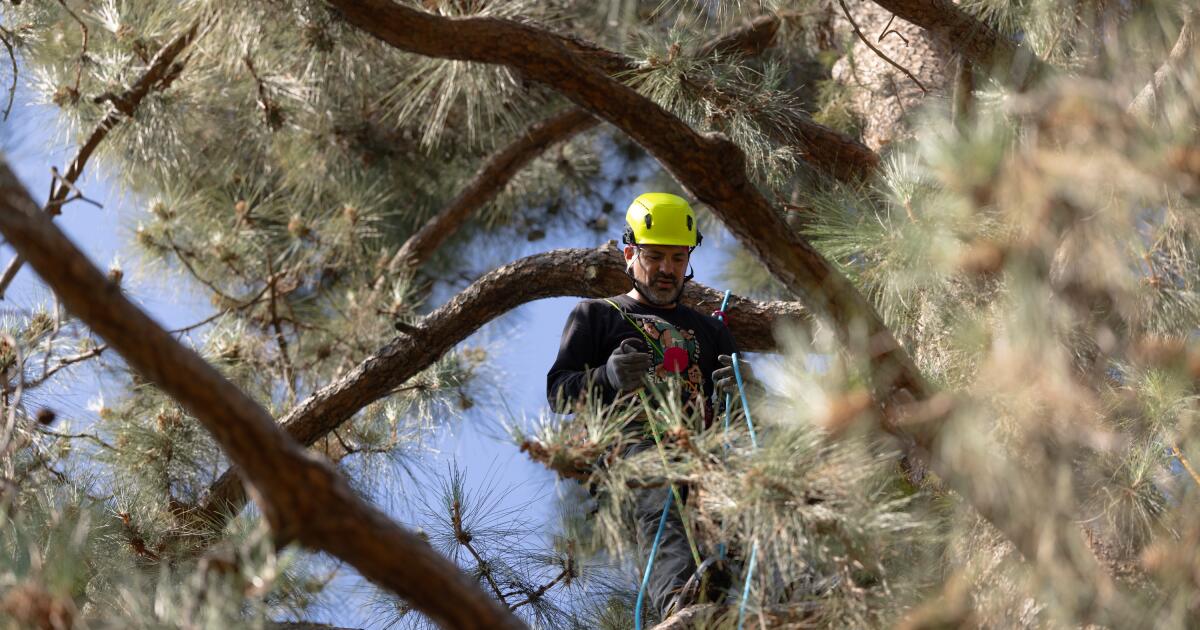
Two teenagers, helped by an arborist, climbed a 100-foot pine tree outside a Pasadena high school Saturday to dramatize a campaign to stop a soil remediation project that calls for the removal of about 200 trees on several school campuses.
Friends of PUSD Trees, a group formed to oppose the removal of the tree, held a low-key protest in front of Muir High School, holding up signs honking at passing motorists and singing along to two drums. But the central act was a quieter, less-seen display of beautiful human interactions with trees.
Several members in harnesses climbed a small tree on the front lawn of the school and hung from its ropes.
“It gives you a sense of being one with nature even though Lincoln Avenue is there,” said Friends founder Jessica Richards, interviewed by phone as she sat 25 feet above the ground in a carob tree. “You feel like you’re away from the city when you’re up in a tree. It’s really special.”
The relaxed atmosphere of Saturday’s event provided a counterpoint to the public uprising that has included the old tactic of an activist tying himself to a tree to stop it being cut down and has now drawn the city of Pasadena and the Pasadena Unified School District into a legal battle.
A person who only goes by the name “Chungus the Squirrel” and Rob Wadleigh protested at a community event against the Pasadena School District cutting down nearly 200 trees.
(Arwen Clemans/Los Angeles Times)
The battle goes back to the January 2025 Eaton fire that spread toxic ash over much of Altadena and Pasadena. According to a schedule posted on the district’s website, following the recommendation of the city’s Department of Public Health, the district conducted soil tests on its 34 campuses and restricted access to many areas where high levels of contamination, especially lead, were found. The county entered into a voluntary cleanup agreement with the California Department of Toxic Substances Control.
Before the 2025-2026 school year, it cleared eight campuses, leaving 11 others, including Muir and Blair high schools, to be cleared.
In February, the county notified DTSC of its plan to remediate contaminated soil, in which its contractor will cut down 193 trees, including some that fall under the city’s tree protection ordinance. The county said it provided plans to the city and received assurances that the plan would not require permits to remove protected trees.
That attitude of the students changed when the residents saw the trees coming down.
Nina Raj, one of the founding members of Friends of PUSD Trees, said she saw three coast oaks and a sweetgum tree being cut down at the Muir campus and stopped the work by committing to one of the four sweetgums scheduled for removal. That tree is standing with its big branches and part of its trunk has been cut down.
A group of friends analyzed the district plan and found it to be exceptional.
“It’s perfect if you want to clean up quickly and don’t care about trees,” says herbalist Nick Araya. “From the beginning, they should have said that these trees should be there, and we should find a solution.”


1. Dey De Guzman helps Sabine Hoppner attach her riding harness at a community event Saturday in Pasadena. (Arwen Clemans/Los Angeles Times) 2. Humberto Mojica speaks to people at a community event against the Pasadena School District cutting down nearly 200 trees. (Arwen Clemans/Los Angeles Times) 3. Trees marked for removal stand at Muir High School on Saturday in Pasadena. (Arwen Clemans/Los Angeles Times)
Critics point to the quilt-like pattern of the poison, rather than widespread contamination, as evidence that lead was present before the Eaton fire and could not be treated with less urgency.
A group of friends prepared their own counter proposal. It will include continued isolation of contaminated sites to prevent student contact and removal of toxins through phytoremediation, an emerging technology that uses plants known to absorb toxins from the soil.
Due to public pressure, the city backed off, notifying the county on June 25 that the project would comply with the tree protection ordinance and permits would be required.
City inspectors have issued stop-work orders to several campuses. According to members of the Friends group, district officials took down the notices and blocked inspectors of school supplies. On July 10, the city obtained a warrant from the Los Angeles Superior Court to inspect county property.
Six days later, the school board voted unanimously in closed session to begin legal proceedings to protect against “disturbance” of school property and, in open session, voted 5-2 to adopt a resolution to “render the City of Pasadena’s Zoning Ordinances Inapplicable to School Properties.”
At that time, the county produced a revised plan that would save some — as many as 57 or 47 — of the 84 uncut trees, said Friends member Jennifer LaPlante.
Forgotten friends.
“Luckily, what’s left are some big, mature trees,” Richards said. “Those who are left must fight.”
Instead of fueling hostility, Friends made Saturday more of a vigil than a protest.
“It’s an opportunity to come together to celebrate trees and discuss with the community to experience trees in new ways,” said Richards.


1. The trees to be cut down are set up at Muir High School in Pasadena. (Arwen Clemans/Los Angeles Times) 2. Nick Araya and Paloma Minuz-Ochoa climb a tree in a community event against the Pasadena School District cutting down nearly 200 trees. (Arwen Clemans/Los Angeles Times)
The climb up the Aleppo pine tower – not one of the trees scheduled for removal – was quiet and slow. piece until la resistance.
Araya, an arborist, dressed Paloma Muñiz-Ochoa, 17, and Maia Atkinson, 17, and taught them one by one how to climb a branch 50 meters from the ground. From there, the three continued, one branch at a time, to the high ground between the crown’s feet.

Flowers and other personal items placed by residents protesting the removal of trees adorn the tree stump at Muir High School on Saturday in Pasadena, Calif.
(Arwen Clemans/Los Angeles Times)
After reaching their goal, Muñiz-Ochoa, Atkinson and the two other climbers who followed them slid down the ropes to solid ground. But they were willing to stay overnight, whatever it took, to stop the removal of other trees, Muñiz-Ochoa said.
He had spent eight hours on the oak tree at the district headquarters on the day he thought it might be cut down and only came down when he was assured the contractors would not return.
“It took a lot of conviction to bring me down,” she said. “I am willing to stay as long as possible, I am willing to continue fighting as long as I will ensure the safety of the trees.”


