
This year, crypto hacks have increased in the total amount stolen and the number of attacks compared to last year. According to a recent report, the industry has lost more than $2 billion in the past 12 months, with more than half of that money allegedly stolen by North Korean hackers.
Crypto Industry Loses $2.2 Billion To Hacks
As the crypto industry has grown, the number of hacks and the total amount lost has also increased. 2024 marks the fourth year in a row that funds stolen in crypto hacks have surpassed the billion dollar mark and the fifth year overall to surpass this figure.
A recent report by Chainalysis revealed that hacks will continue to persist in 2024, increasing by 21.07% year-on-year (YoY). The total amount stolen rose to $2.2 billion, $400 million more than 2023 and the third largest year by this metric.
In addition, 2024 was the year with the most hacks, reaching 303 incidents in December. This figure represents a 7% increase from 2023’s 282 attacks, but Chainalysis highlights a significant change during the year.
According to the report, the intensity of crypto hacks has been reduced after July, when the accumulated amount stolen since January has already reached $ 1.58 billion. This figure was about 84.4% more than the amount stolen during the same period in 2023.
Number of crypto hacks increase in 2024. Source: Chainalysis
Based on this, Chainalysis analysts speculated that “the ecosystem was easily on track for a competitive three billion+ years of 2021 and 2022.” However, the 2024 increase decreased significantly at the end of July, remaining stable throughout the year.
Central exchanges (CEXs) were the most targeted platforms in Q2 and Q3, recording some of the biggest events in the sector’s history. The DMM Bitcoin and WazirX hacks took in nearly $540 million between May and July, with the former becoming the third largest crypto hack in history.
Decentralized financial platforms (DeFi) accounted for the largest share of stolen assets in Q1, as in most quarters between 2021 and 2023. Meanwhile, compromise of private keys was the largest type of compromise, accounting for 43.8% of incidents.
The report also noted that cybercriminals have turned to bridges and mixing services to dispose of ill-gotten funds, while criminals from other attack vectors are opting for Decentralized Exchanges (DEXs).
North Korean Hackers Take 60% of Stolen Funds
According to Chainalysis, hackers from the Democratic People’s Republic of Korea (DPRK) stole more from crypto platforms in 2024 than in any other year. This year, the total amount allocated increased by 102.88% from 2023, from $660.5 million to $1.34 billion.
The number of events increased from 20 to 47 in 2024. These figures represent 20% of all incidents and 61% of the total amount stolen this year. Additionally, crypto attacks linked to North Korean hackers are becoming more frequent and profitable.
Attacks between $50 million and $100 million, and above this price range, were more common this year, “suggesting that the DPRK is getting better and faster at large-scale exploitation,” the report added.
It is worth noting that in the last two years, North Korean exploiters received less than $50 million in ill-gotten gains per incident:
When we evaluate the DPRK’s activity against all the other hacks we have measured, it is clear that the DPRK has been responsible during the last three years for exploits of a large size. Interestingly, the DPRK’s dominance of the top end of the hacking ladder continued in 2024, but there is also an increasing density of DPRK hacks at lower prices, especially the $10,000 price tag.
Chainalysis highlights that North Korean IT workers are increasingly entering crypto and Web3 companies, jeopardizing networks, operations, and integrity. However, it notes that the majority of DPKR-related activity occurred earlier in the year, with overall hacking activity stagnating in Q3 and Q4.
Finally, the report suggested prioritizing “careful recruitment (…) while maintaining a strong encryption key to protect valuable assets, if any.”
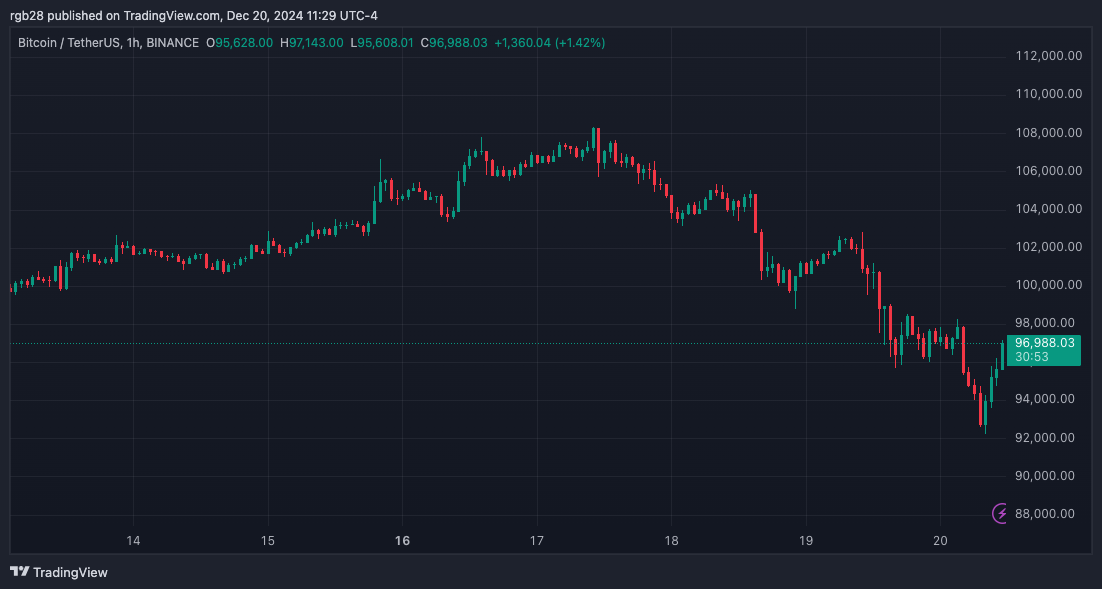
Bitcoin's performance in the one-week chart. Source: BTCUSDT on TradingView
Featured image from Unsplash.com, Chart from TradingView.com
Source link