
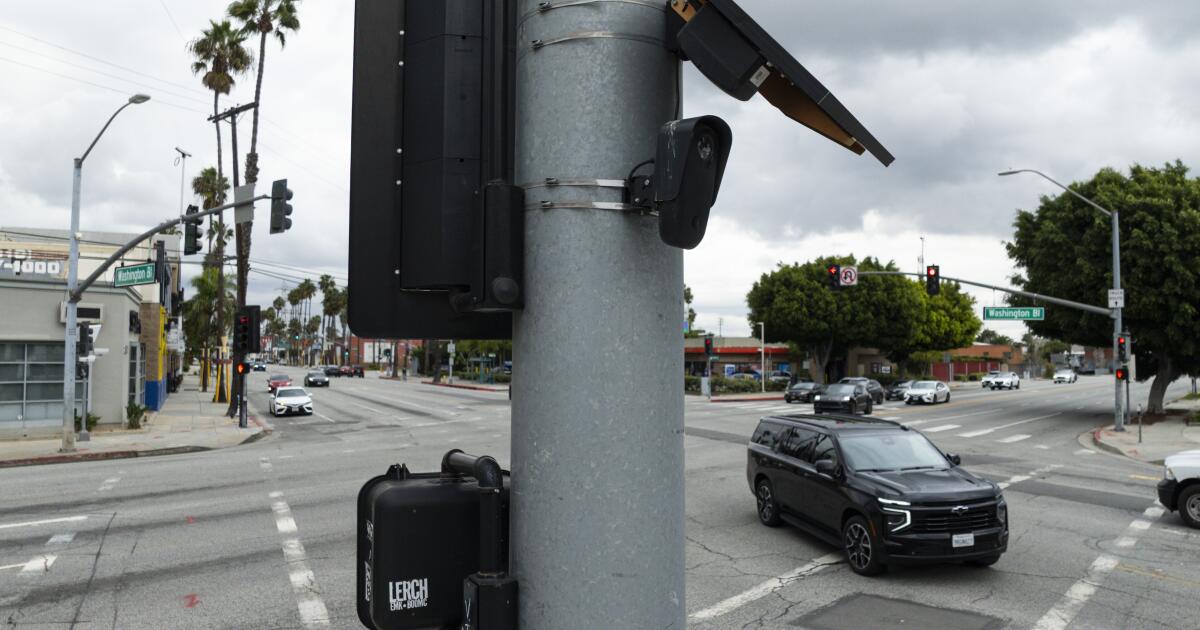
Less than a week after the Los Angeles Police Department announced it was ending its relationship with Flock Safety over concerns about how the company shared data collected from automatic license plate readers across the city, police officials said they were in the process of working out a new deal — this time with more protections.
Flock has been criticized for sharing its data with state and federal law enforcement agencies, which opponents say helps fuel the Trump administration’s crackdown by giving authorities the power to track the movement of undocumented immigrants.
The Atlanta-based firm is one of three vendors used by the city to read automated license plates. The devices capture license plates of passing vehicles, which police say helps them locate vehicles reported stolen or linked to suspected criminals.
Flock uses cameras placed on 138 poles around the city, as well as possibly hundreds of private ones. Cmdr. Randy Goddard, head of the Information Technology Bureau, told the Police Commission on Tuesday that department employees no longer have regular access to the information collected by the company, but the information is stored in the cloud and could be accessed by LAPD investigators in the future if the new contract is finalized.
Goddard said the department approved its previous operating agreement with Flock last week because of persistent questions about who owns the data collected by the company’s license plate readers and who has access to it.
Under the language of the department’s proposed new contract with Flock, the LAPD would retain ownership of “all images, all records, all metadata” on the data captured by the cameras. Goddard said Flock will not be allowed to “sell, publish, disclose or share” any data with any third party or use it for training artificial intelligence or other commercial uses.
Under the proposal, the company would also be required to notify the city in writing within 24 hours of any data breach.
Dean Gialamas, LAPD chief of staff, said Flock sent the department a proposal for changes to the proposed contract on Monday.
A spokesperson for Flock did not immediately respond to an inquiry from The Times.
Flock said he contracts with about 5,000 law enforcement agencies across the country and that his expertise complies with California law that limits what information can be shared with federal authorities.
Speaking to the Police Commission on Tuesday, LAPD Chief Jim McDonnell called Flock’s plate-reading technology “an important investigative tool,” but one that must be handled “responsibly.”
Aside from concerns about data storage and sharing, a recent report from LAPD Inspector General Matthew Barragan found that the department’s license plate readers — known as ALPRs — have vehicles that are not reported stolen many times.
In a two-month period beginning last August, Barragan’s report said, Flock’s cameras scanned more than 210 million license plates. In 161 cases, according to the report, a plate flagged as stolen turned out to be incorrect – although not all of those cases led to police intervention. The report found that 337 alerts led to the recovery of a stolen vehicle.
Barragan’s report said the department has no formal contracts or agreements with its two other license plate reader vendors — Axon and Motorola — “to address ALPR’s requirements for data security, privacy, and access control.”
Barragan’s report said there are many “limitations” in the department’s existing agreements with the three companies, including a lack of clear language about how long data is kept and how it is shared with third parties or other law enforcement agencies.
A number of smaller law firms have severed ties with Flock in recent months. News reports indicate that the San Francisco Police Department became the largest department yet to terminate its relationship with the company after a routine audit found that multiple out-of-state and federal agencies accessed its data, possibly in violation of state law.
In late May, LA City Council Member Ysabel Jurado was introduced the movement asked the police commission not to enter into any further contracts with Flock or its affiliates.
In a statement following the LAPD’s decision last week to end its relationship with Flock, Jurado called for “a full accounting of who accessed this data, whether any outside agencies are using LAPD-controlled systems, and how the privately funded cameras are connected to the law enforcement infrastructure.”
In a press conference before Tuesday’s meeting, several civil society groups opposed to the expansion of Flock in the city asked the Ministry to end its relationship with the company.
Mau Trejo, director of strategic communications for Students Deserve, a group that advocates for Los Angeles schools to “defund police and protect Black lives,” urged LA to follow the lead of other cities that have permanently ended their contracts with Flock.
“Our city has prioritized the use of vigilance as a safety measure, but that is not what is happening in our schools on our streets,” he said.
Despite the resistance, the cameras have a lot of support from LAPD boosters, homeowner associations and elected officials. they have oppressed the city to speed up their installation.
The LAPD inspector general’s office said it will hold a hearing session to gather public feedback on the department’s use of license plate readers on the afternoon of July 30.
Times staff writer Dakota Smith contributed to this report.


