
This post was originally published in 2019 and was updated in 2024
with Terrell Heick
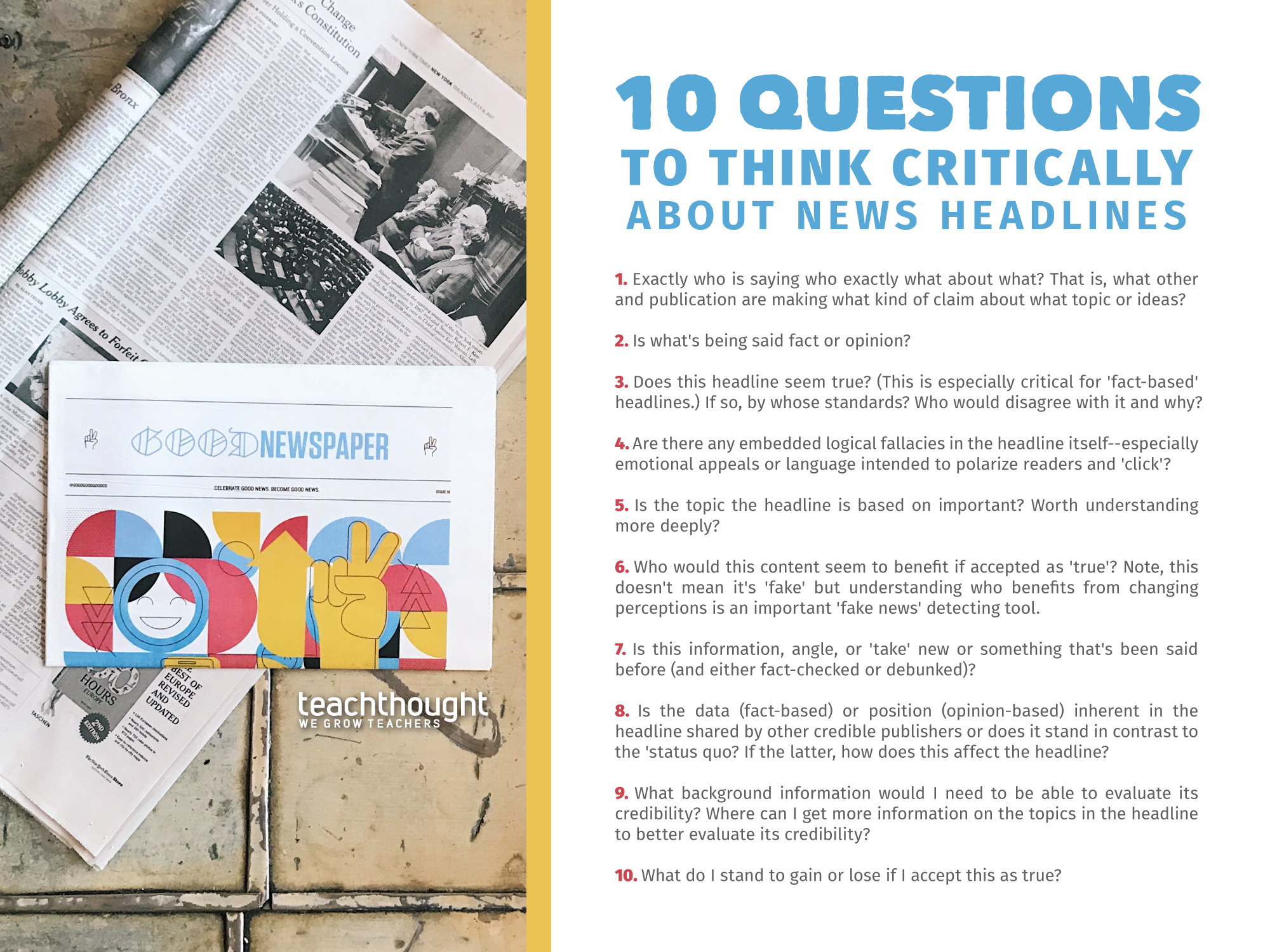
1. In an article, topic, or social sharing, ‘who’ says ‘what’? That is, what specific author and publication are you looking for on a topic or ideas?
2. Is what is said or implied fact or opinion?
3. Does this article seem true? (This is especially important for ‘fact-based’ articles.) If so, by whose standards? Who would argue against it and why? How to check the truth? Does the author use the ‘grey areas’ of ‘truth’ in a way that seems designed to stir up confusion, doubt, influence thinking, or change the readers’ opinion?
4. Is this article completely ‘true’/accurate or instead based on partially true information/data? Misleading information is usually based on partial truths and then rearranged to suit a specific purpose: to cause a feeling like anger or fear that leads to some kind of result: a ‘like,’ a donation, a purchase, a subscription, a vote, etc.
5. Are there logically embedded flaws in the topic itself–especially masculine arguments, emotional appeals, or strong language intended to alienate, unite, or ‘engage’ readers?
6. Is the subject of the article based on what is important? Is it worth a deeper understanding?
7. Who will this benefit if it is accepted as ‘truth’?
8. Is this information, angle, or ‘take’ new or something that has been told before (and fact-checked or analyzed)?
9. Is the data (fact based) or position (opinion based) found in the article shared by other trusted publishers or is it different from the ‘status quo’? If the latter, how does this affect the topic?
10. What background information would I need to be able to assess its credibility? Where can I find more information on the topics in the article to better assess its credibility? What will I gain or lose if I accept this as truth?
11. Does a ‘news story’ accurately represent the ‘big picture’ or is it a ‘selected’ element (in or out of context) designed to evoke an emotional response in the reader?
For a second set of questions to think critically about news headlines, we turn to the News Literacy Project, a media standards project that created a set of questions to help students think critically about news headlines.
12. Check your emotional reactions. Is it powerful? Are you angry? Do you have high hopes that the information will be true or false?
13. Think about how you experienced this. Is it promoted on the website? Did it show up on your social media feed? Was it sent to you by someone you know?
14. Consider a topic or message:
a. Does it use excessive punctuation or ALL CAPS for emphasis?
b. Does it say it contains a secret or is it telling you something the ‘media’ don’t want to know?
c. Don’t stop at the topic. Keep checking!
15. Is this information designed to be easily shared, like a meme?
16. Consider the source of the information:
a. Is it a known source?
b. Is there a line (author’s name) attached to this piece? Does the writer have any expertise or experience?
c. Go to the ‘About’ section of the website. Does the site describe itself as ‘fiction’ or ‘funny stories’? What else do you notice – or don’t notice?
17. Does the example you are analyzing have a date on it?
18. Does the example cite a variety of sources, including official and professional sources? Does information for this example appear in reports from (other) news outlets?
19. Does the example link to other quality sources?
20. Can you verify, using reverse image search, that any of the images in your example are authentic (ie, they have not been altered or taken from another context)?
21. If you searched for this example on a fact-checking site such as snopes.com, factcheck.org, or politifact.com, did any fact-checking label you as less than true?
Remember:
- It’s easy to put together an existing website and create fake tweets to trick people
- AI and ‘deep lies’ have become commonplace
- Bots operate on social media and are designed to dominate conversations and spread propaganda.
- Propaganda and/or misinformation often uses an actual image from an unrelated event.
- Debunk examples of misinformation whenever you see them. It is good for democracy!
You can download the full ‘checkology’ pdf here and find more resources at checkology.org
Source link